Quiet questions
How do I become a LiW tester?
By filling in the form at the bottom of this page. The beta is private and you get in by invitation: we are looking above all for people who do not feel up to motorways, ring roads and expressways, and for those who drive vehicles that are not allowed there at all. Places are few, and applying does not mean getting the invitation straight away: whoever stays out now, we keep for the next round. Of those who get in we ask that they use it and tell us when something is wrong, and when LiW comes out everyone who helped receives a code to have it for free.
How is it different from the “avoid motorways” option of other sat navs?
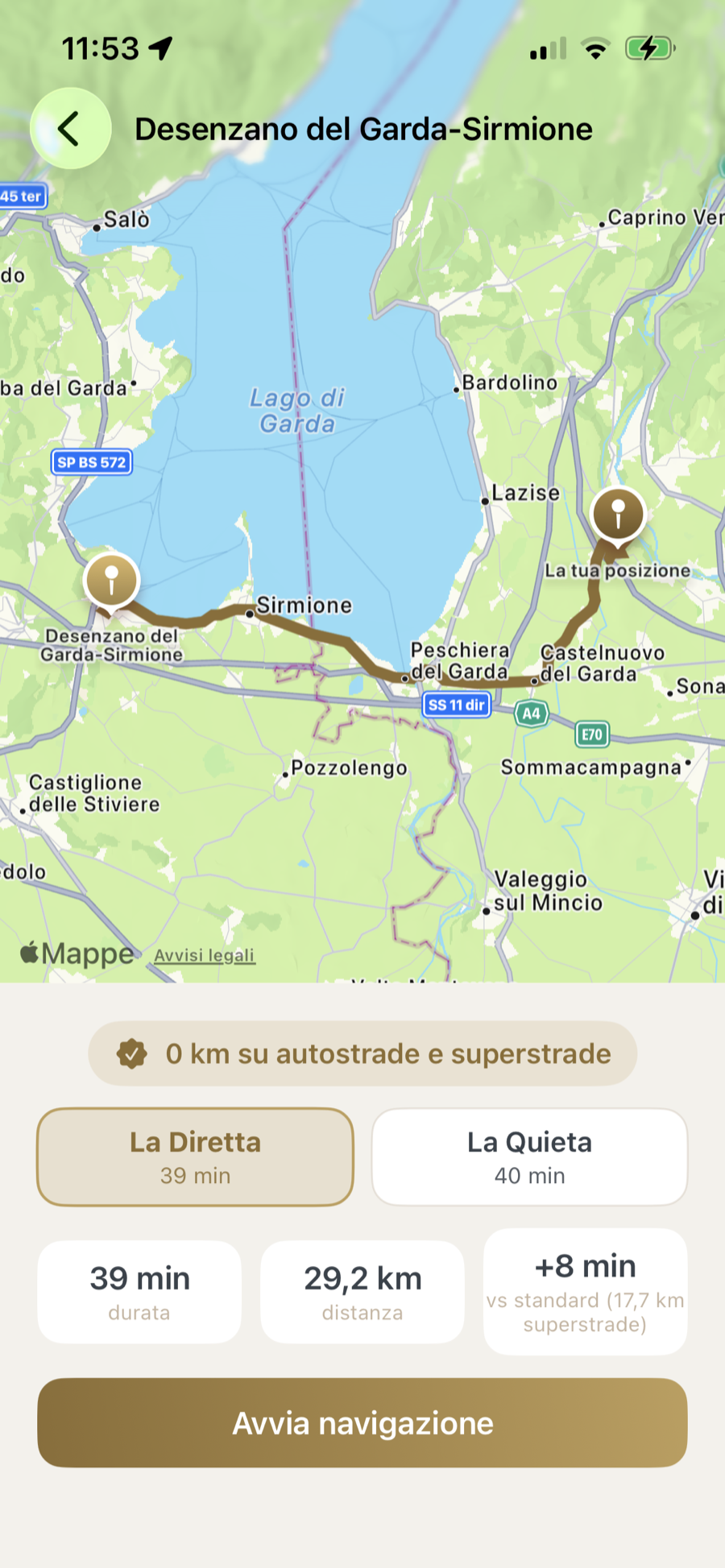
In ordinary sat navs “avoid” is a preference that can give way, and it only covers motorways. LiW never takes you onto motorways, ring roads or expressways! Its claim “0 km on motorways and expressways” is real.
Why “The road that breathes”?
Because on local roads, whether you travel for pleasure or for work, the pace is slower: you feel that this time has meaning too, you feel less anxious, and the destination is only the last part of your journey.
Where does LiW work?
All over Italy, Austria and Switzerland, village by village. In Austria and Switzerland, avoiding the motorway also means not buying the vignette. Other countries will come calmly, as they should.
How much longer does it take?
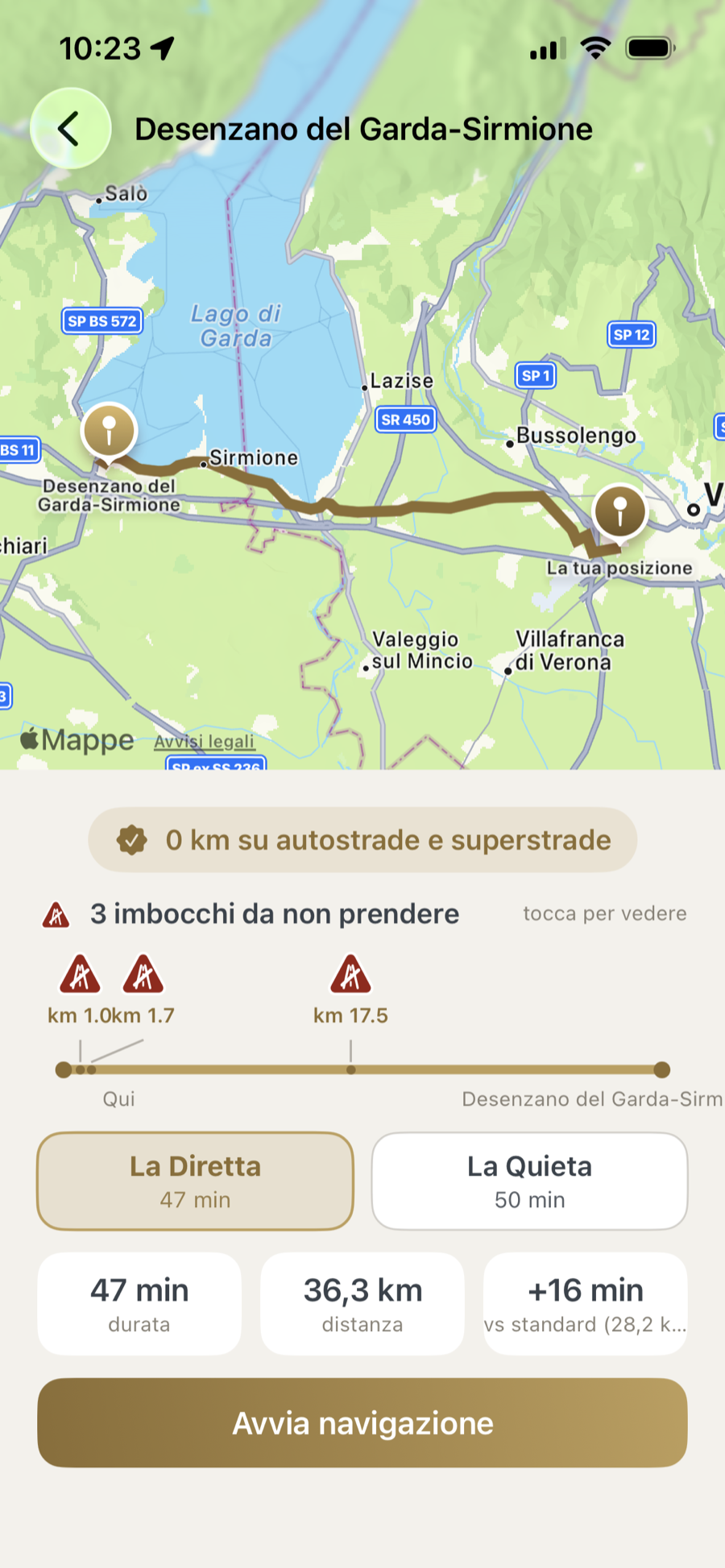
It depends on the journey, and less than people fear. On short trips, in town and nearby, often nothing changes: traffic lights and roundabouts count for more than toll booths. On long journeys the difference shows, and that is the honest part of the deal: LiW does not sell you the shortcut, it sells you the road you can actually drive. You see the estimated time before you set off, on the route preview, and you decide.
Can LiW help someone with amaxophobia?
Amaxophobia is the fear of driving, and it doesn’t come in one shape only: some people are fine in town and freeze at the motorway entrance, some can’t stand tunnels, bridges or queues, some fear being left without exits or going too far from home, some stopped after a crash and some couldn’t say when it started. It often brings panic attacks with it, and the anxiety of the days before a trip.
It is a wide territory, and nobody can map it from the outside: two people using the same word may be describing very different things.
So let’s say it plainly: LiW does not cure, it is not a therapy and it replaces nobody. Someone with amaxophobia finds help in a specialist, not in an app.
What LiW can do is take away one part of the problem, when that part is the road: if what stops you are motorways, expressways and ring roads, LiW gets you there without ever going near them, and before you leave it shows you the whole trip, with the delicate spots. For some people that is the difference between giving up and going. For others it won’t be enough, and it’s only fair to say so.
I ride a moped. Can I use LiW?
Yes, and that is one of the reasons it exists. Mopeds, microcars, light quadricycles, farm vehicles and in general anything not allowed on motorways need a route that never sends them there. Other sat navs suggest it anyway and leave you facing the no-entry sign: LiW does not, because it never uses those roads at all.
Do I need an internet connection?
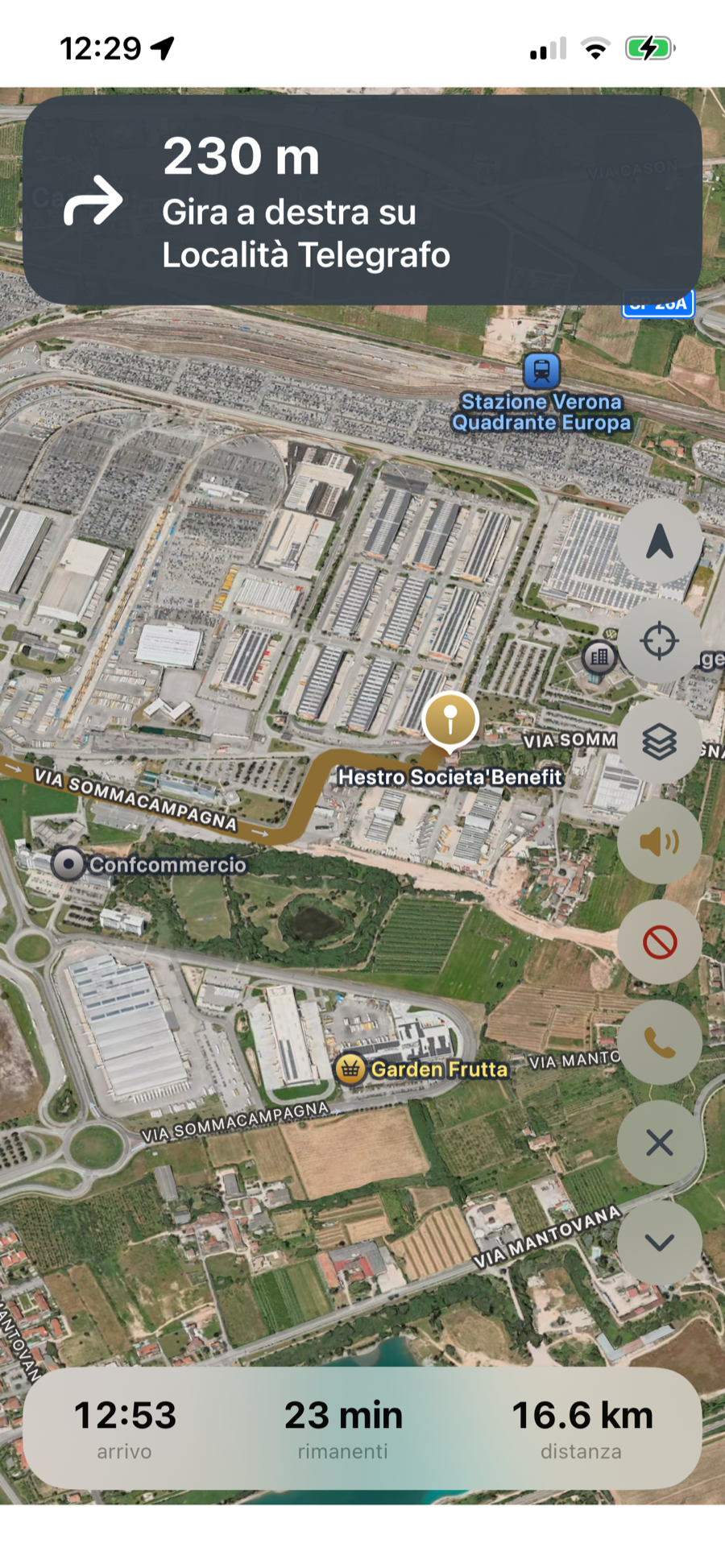
You need one to work out the route: the road is drawn by our engine, which lives on a server. Once you are on your way, if the connection drops the guidance carries on along the route already calculated, and we say so with one line on screen, without alarms. What you lose without a connection is recalculation, if you leave the route, and searching for a new address.
Does the voice drown out the music?
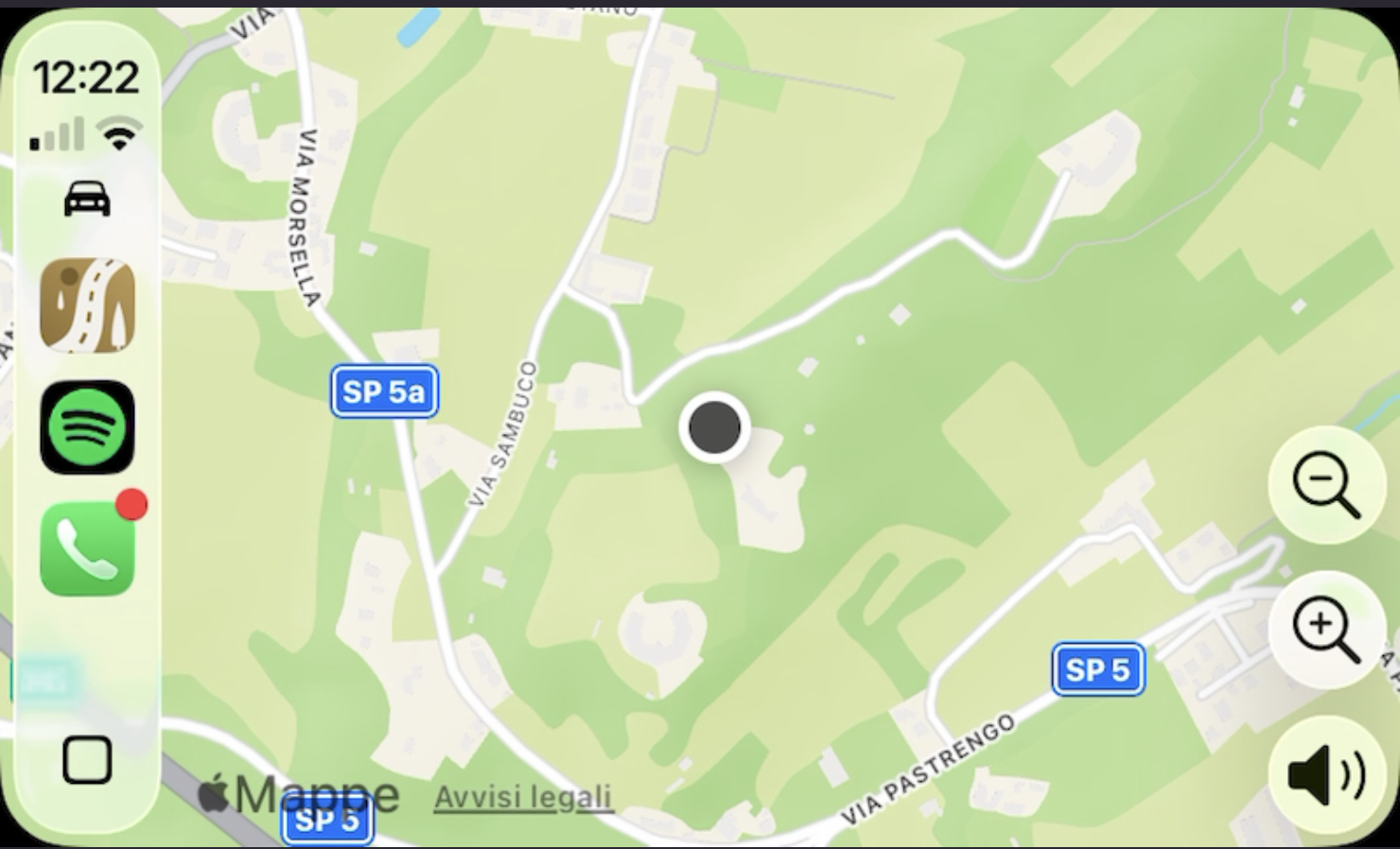
No: it turns the music down for as long as the sentence lasts, then the music comes back to its own volume. A podcast or an audiobook is paused and resumes by itself, because words over words cannot be understood. And the voice can be switched off with one tap, from the car’s display too.
Why does LiW not show traffic?
Because on the roads it takes, traffic matters less than you would think: real queues are almost always on ring roads and motorways, which is exactly where LiW does not go. The times you read are worked out on the road, not on the traffic of the moment: take them as an honest indication, not as a promise to the minute.
What phone do I need?
An iPhone with iOS 17 or newer, or an Android phone with Android 10 or newer. In the car LiW appears on the dashboard screen: CarPlay on iPhone, Android Auto on Android.
Where do the roads come from?
From OpenStreetMap, the free map that hundreds of thousands of people build all over the world. On that data we built the routing engine, teaching it never to use motorways, expressways or ring roads. The map you see on screen comes from OpenFreeMap on Android and from Apple on iPhone. © OpenStreetMap contributors: without their patient work, LiW would not exist.
What happens to my location?
It stays on your phone. While you drive it never leaves it: we do not transmit it and we do not record it. When you ask for a route, only the starting point and the destination reach our engine, with nothing that says who you are, and they are not kept. The places you save, Home, Work and your favourites, stay on the phone as well.
How much does it cost?
LiW will be a paid app, with a yearly subscription. We will announce the price when the app launches: we would rather say it once and say it right, than write it now and change it later. Those helping us test it will know first.
Do I need an account?
No. Download and go. Your places stay on your phone.
What if I end up on a ring road by mistake?
It happens, and nothing happens: LiW recalculates at once and the route resumes from the nearest ordinary roads. No scolding.
What if I press the LiW button by mistake?
Nothing irreparable happens. Before setting a stretch aside LiW asks you, and the trip in progress does not change anyway. The roads you set aside stay in a list: you let them back in with one tap, from your phone or from the car’s display.